


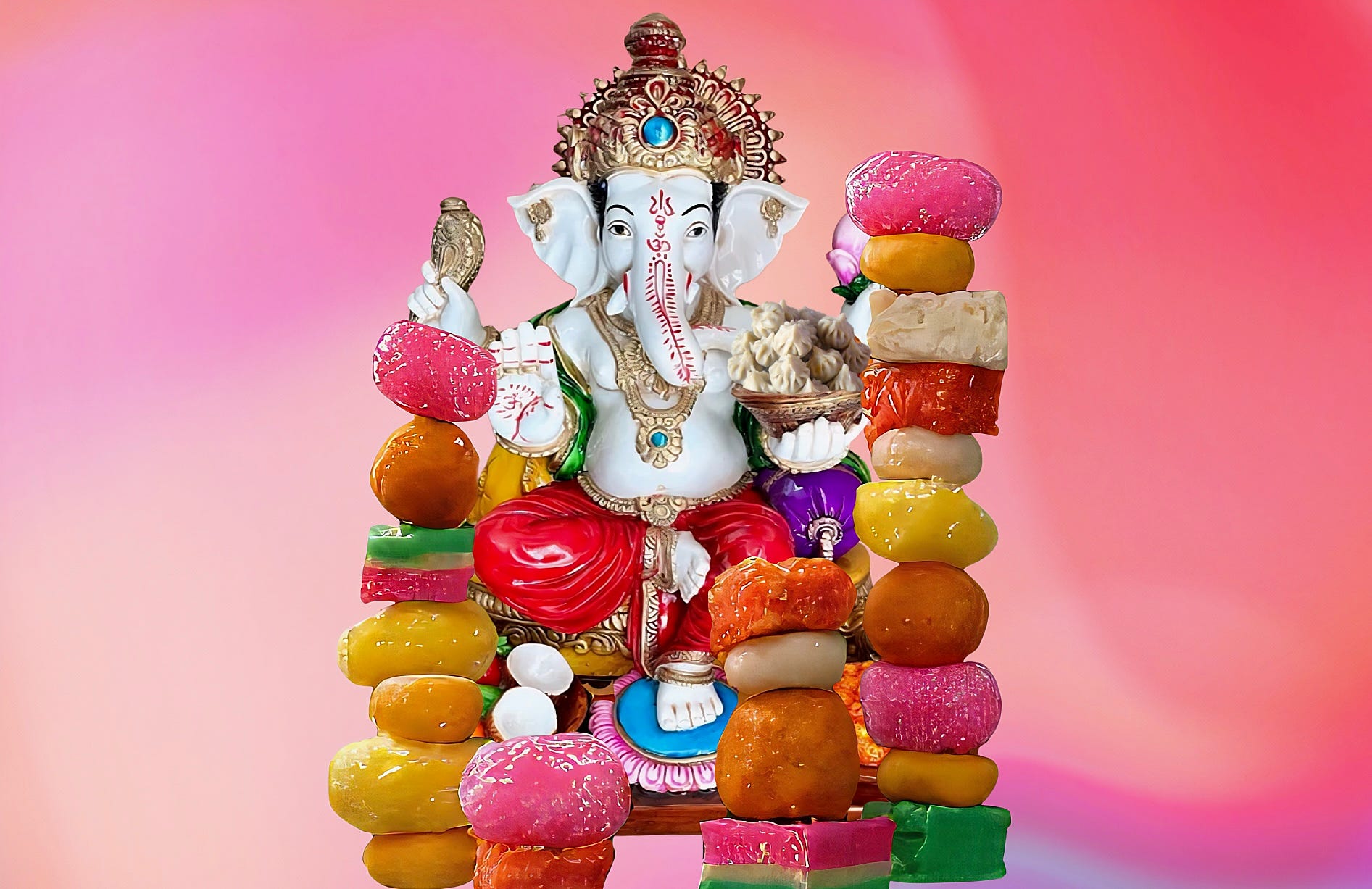
That sweet taste
If we take half a step back, we might ask why humans are so into sweets.
According to Ayurveda, of the six tastes, our food is predominantly sweet. Meat and fish are sweet. Grains are sweet. And then sweets are sweet.
Sweetness is something I have felt deeply connected to since childhood—sweetness as an ineffable inner feeling and also what I'm seeking.
When I was a little girl, I didn't have all the words I have now. But there was something like a sweetness that I felt in myself and that I was looking for both in other people and in a more cosmic way. I called that cosmic sweetness “the Friend.”
Much later, I learned from my spiritual traditions that the essential taste of life is sweet. There's a sweetness to existence, or what we call the natural state. We seek sweet tastes in foods because they are connected to the primordial sweetness, however distantly.
If you contemplate the sweet taste of a candy bar and then the sweet fragrance of jasmine flowers, you can have some understanding of the continuum from a more tangible sweetness to a more subtle, ineffable sweetness.
The God spectrum
Learning to remain resting in primordial sweetness is one way of describing self-realization. But for those of us who might need an eensy-weensy bit more time to accomplish that, do not despair. Many forms of sweetness are available to everyone. That is the mercy of this world.
All sweetness is an aspect of the sweetness. We can pause to notice and savor sweet tastes in food, people, other animals, nature, music, art, the sounds and textures of every day, in words and worship.
Eventually, we can discover that eternal sweetness in ourselves. This is the real refuge.
Bringing more ordinary sweetness into our experience and developing habits of pausing to notice and enjoy sweetness can sustain us through the most difficult times.
Sweet tastes of all varieties are strengthening, and they build resilience. They also promote relaxation. We relax because sweet tastes remind us of the goodness in ourselves and that the fuller realization of goodness is our destination.
This is why, while enjoying ordinary sweets, we are both satisfied and dissatisfied.
We are satisfied by the feeling of fulfillment that sweet tastes provide, but dissatisfied because, even if unconsciously, we recognize that our small sweetnesses are aspects of the sweetness we have yet to entirely encounter.
Our yearning for ordinary sweets is on a spectrum with our yearning for God.
This is also why we often eat too many sweets. We keep eating because we are yearning for that final destination. Eventually we discover that our yearning is also sweet. Step-by-step, refining our sweet “palette,” we discover the beneficence at the heart of reality.
Accompanied by sweetness
One day recently, I was feeling particularly at a loss as to how to engage with our collective situation here on Earth. I told a student: “I’m just going to hunker down at home with my own sweetness.”
I was making a joke, but not.
Globally, we humans are being forced to face our worst propensities on a scale of epoch-changing significance.
I keep flashing on that famous scene in A Clockwork Orange. Alex, the main character, is buckled into a chair with his eyes forcibly held open and his system flooded with nausea-inducing chemicals while he watches scenes of fascist violence and sexual assault. The idea is to get him to associate nausea with these brutalities so that he will not be able to commit such acts even if he wants to.
Of course, this is not literally making him a better person or helping him to discover primordial goodness.

But on some level, we are all sitting in that chair with Alex. And while we are sitting there watching or experiencing directly our fellow humans commit the most greedy, murderous, and wantonly cruel acts—the room is crowded with angry (mostly white men) shouting lies and deprecations. And all around us, our home is under assault, and people and animals are dying because we refuse to take proper care of each other and our world.
We do have to see. We do have to acknowledge the worst aspects of ourselves and the consequences of our actions. But the way through this is to simultaneously remain in contact with our sweetness.
And so, I am going to share with you some stops along the sweetness spectrum—from the most tangible and accessible to the more subtle.
My fervent prayer is that you, too, will always be accompanied by sweetness as you do what you can to take care of yourself and all of us.
I’m going to start with food. In subsequent articles, I’ll bring the music, art, lifeways, and practices that have sustained me through whatever we are going through together.
Here are some of my sweetest things.
Deep sweetness
Sweetness is not just sugar. It’s also how a thing is made, who it’s made by, what it’s made of, and how everyone along the cascade of the creation of a thing is treated.
When we eat (or drink) this deep sweetness, it sends messages of sweetness, care, compassion, and devotion into our bodies, minds, and hearts.
Chocolate
Tastes: bitter, sweet, astringent, very mildly pungent
Chocolate is the best reason to visit planet Earth. Speaking from an alien’s perspective, of course. But the aliens better get here soon, because cacao agriculture is being severely affected by global warming.
With that in mind, my deepest sweet chocolate is made by Mandala Naturals.
Mandala is B Corp Certified. Their chocolate is organically and regeneratively grown. 10% of their profits go directly to their Regenerative Forest Farm Initiative, and they maintain direct trade with family farms that ensure fair wages and sustainable farming practices.
They also produce just about the best chocolate I’ve ever tasted.
Mandala is pricy, though. If you’re looking for deep sweetness without the high price tag, try Divine chocolate. It’s available in a lot of grocery stores.
Divine is also a B Corp and the only chocolate company co-owned by cocoa farmers: the Kuapa Kokoo cooperative in Ghana. The company pays Fairtrade prices on every possible ingredient, funds community programs such as literacy and numeracy courses, and shares profits with its farmers. Divine has been recognized for multiple years by B-Lab as "Best for the World: Communities."
Tea
Tastes: bitter, sweet, astringent
High-quality black tea, what I mostly drink, is surprisingly sweet. Especially with milk and maple syrup. ☺️
The best innovation in tea is the fairly recent surge in plantation to consumer sales. This trend results in better labor conditions and life opportunities for tea workers and fresher tea for you
Teabox is an Indian-owned, farmer-to-you outfit that supports tea plantation workers by favoring tea estates that provide fair wages, better working conditions, and that operate with sustainable growing practices. Many of their tea offerings are organic.
Mana Organics is the sales arm of a woman-led, Indian tea-producing family that owns three tea estates. They practice organic farming and superior labor practices that include providing health care and childhood education for the families of workers. This is practically unheard of in the notoriously worker-averse Indian tea industry. Mana was featured in World Tea News as an example of an ethical tea company.
Coffee
Tastes: Bitter, sweet, astringent, sour, pungent
Sweet here only applies to fresh, high-quality beans. The crappier the source, the less sweetness. Figures.
I only recently started drinking coffee again after a long time of near total abstention.
Over the past few months, I’ve sampled about a dozen brands of organic beans.
I can state categorically that Heirloom Coffee Roasters in Oakland, California is where you want to get your deeply sweet beans. Their coffee is organic and mold and mycotoxin free. Every interaction I’ve had with them has been, well, sweet. The coffee is bar none the best I’ve ever had.
I’ll just quote from the co-founder. You can’t get sweeter than this.
"After witnessing the devastation caused by unsustainable farming, unethical labor practices, harmful chemicals, and mass-production coffee roasting that prioritizes profit over quality and integrity, Heirloom Coffee Roasters was born to ignite change.
… This isn’t just about an exceptional cup of coffee. It’s about integrity in every step of the process.
100% Regenerative Organic Certified® farming, chemical-free cultivation, in-house proprietary precision-driven roasting, and innovative, sustainable packaging. … Every element is designed to honor the earth, uplift farmers, preserve artisanal techniques, and protect your health.”
Milk, butter, yogurt, sour cream, buttermilk, and eggs
Tastes: Sweet, sour
The dairy industry is rightly under fire, and sometimes under boycott, due to its grotesquely cruel treatment of animals and our enviornment.
Alexandre Family Farm is a certified regenerative, grass-pastured A2/A2 organic dairy in California. They also pasture their chickens 365 days a year and practice mobile coop egg farming so that their hens have unrestricted freedom to forage, eating from 50-100 varieties of plant species.
As an animal rights activist friend said to me: “If you’re going to consume dairy, this is the best you can choose.” And just to be fair, she doesn’t support consuming dairy! That’s a me thing.
You can find Alexandre in many grocery stores nationwide, but not all of their products are available outside of the West Coast. If you live elsewhere, read the Alexandre website, and you’ll know what to look for in dairy farms in your area.
Maple Syrup
Tastes: Sweet, astringent, subtly bitter
Maple syrup, my sweetener of choice, is also suffering from global warming. Many maple producers in Maine and Vermont are now forced to supplement their harvests with syrup from Canada.
Along with global warming curtailing the harvest, maple syrup prices have gone up pretty steeply over the past decade. I have been completely priced out of my favorite organic maple syrup from Maine: Coombs.
After much searching, I found Schanz Family Maple, a lovely rich and authentic Maine family-produced syrup on Etsy. It’s not certified organic, but that is par for the course for many Maine farmers. They practice organic farming, but they cannot afford, or just choose not to pay for certification. Rebels.
Here’s what Schanz says about their product:
”From the tree to the consumer, we oversee every step of the maple syrup making process to ensure that we are making a product that is not only delicious, but untainted from chemicals or pesticides.”
The Sweet Series
I’m going to keep moving from the most tangible sweetness to the most subtle. Stay-tuned for more of my sweetest things from cooking things to home accoutrements to clothing to music and art and certifiable spiritual practices that will get you more in touch with the sweetness of life.
Let’s find our sweet and then go out and share the sweetness and do all the things to create a sweeter future together.
with infinite love,
Shambhavi

Not quite ready to fire up a paid subscription, but want to show your appreciation?

Please join Shambhavi and the Jaya Kula community for satsang & kirtan every Sunday at 3:00pm Pacific. Come in person to 1215 SE 8th Ave, Portland, OR, or join Jaya Kula’s newsletter to get the Zoom link for satsang. You can also listen to my podcast—Satsang with Shambhavi—wherever podcasts are found.