


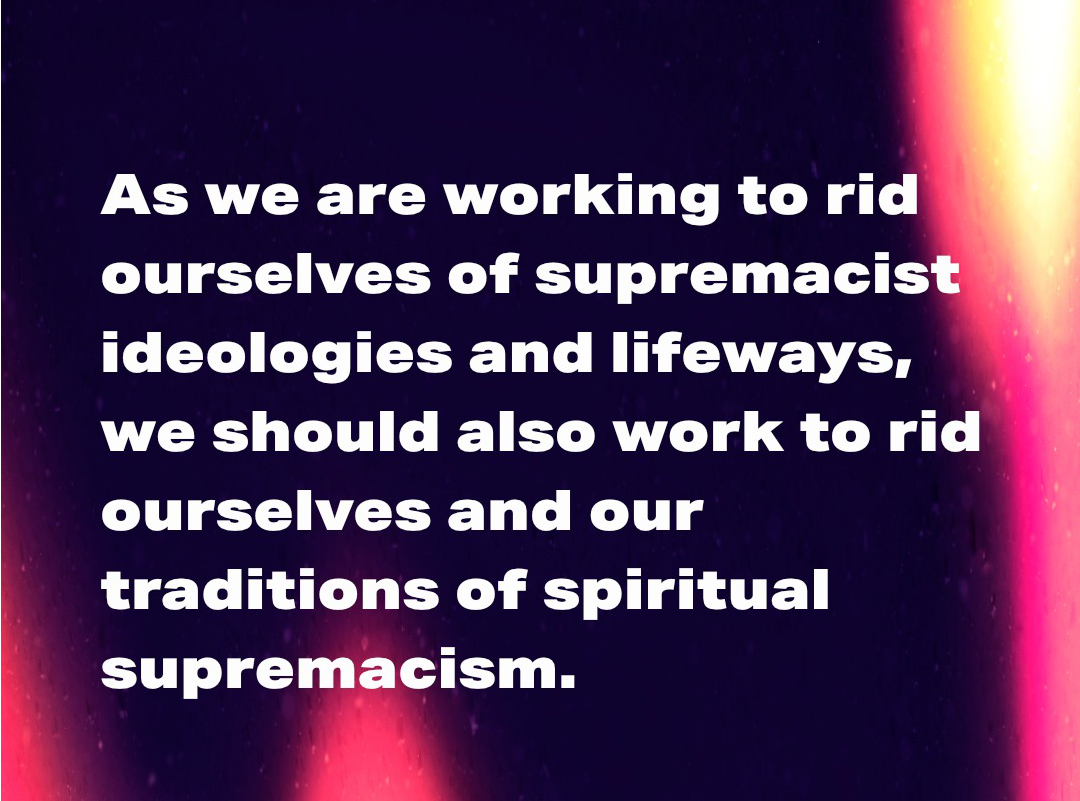
After I posted the above image to social media, someone asked me: What is the opposite of spiritual supremacy? Here is a beginning of a response.
"It may be asked, why there cannot be one and the same path for all? Because God reveals the Self in infinite ways and forms — truly, the One is all of them." ~Anandamayi Ma
Everything is good for someone
Some spiritual practitioners benefit from structure and vows.
Some are magnetized by the search for Truth.
Some naturally gravitate toward austerities and renunciation.
Some cannot eat animals.
Some need saviors and saving.
Some are are drawn to a more intellectual path.
Some love to weep at the feet of deities.
Some worship wrathful, punishing gods.
Some revere their teachers above all.
One of the first lessons I learned from my Sat Guru Anandamayi Ma was to respect every spiritual tradition as an expression of the one Self, the self-aware ground of existence.
The infinite varieties of spiritual traditions and practices exist because beings are infinite in their variety.
When flooded with natural devotion, devotion in any form became dear to me. Devotion to a craft. Devotion to a people or other beings. Devotion to tending spaces and things. Religious devotion, even if housed in traditions very different from my own.
To entertain the notion that all traditions contain the possibility of revealing wisdom, even traditions or teachers that cause harm, is a starting point for dismantling spiritual supremacy.
But this is not to erase differences. Ma also taught that traditions have more partial or less partial views. With our sincerity, we can complete a tradition and then a path with a wider view naturally appears.
Ma compared this to taking a cart to a train. She said that when you arrive at the train, get on it. But don’t look back and denigrate the cart as it carried you to the train.
The great equality
We already have traditions here on Earth that do not tout themselves as the best or their adherents as somehow special and their gods as the highest.
There are traditions that do not operate on a spectrum of pride to shame or reward to punishment.
There are traditions that do not ouster other beings or discard them into categories such as “evil” and “sinful”.
I don’t know all of them, but my own traditions contain at least this promise.
My spiritual traditions have histories of breaking rules in order to more faithfully follow wisdom.
They also honor blending so seamlessly into circumstances or cultures that you enjoy a kind of sublime invisibility.
We have histories of natural transmission superceding institutional lineages.
We have histories of magic, poetry, divination, and medicine.
We are messy and decentralized.
We aren’t on a mission. All of our seeking teaches us that manifest life is an infinite theater. Our seriousness about getting somewhere is just part of that.
At least in theory, we are a zone of belonging for those who have been othered.
No matter what the outward display, devotion is the essence.
We don’t plan too far ahead. We just follow the profound instructions inherent in each moment.
Responsive improvisation is our method of travel.
We value following over leading and leading by following.
We understand all traditions, including our own, as displays of impermanence, but what gives rise to them we call the eternal.
And so we gleefully look forward to the obsolescence of our own teachings, but not of what they point us toward.
The eternal, the natural state or ground of existence, is continually moved even though, being everywhere, it has nowhere to go.
We would not call it unmoving because its livingness is overwhelming. It is full of virtue and intelligence, creative impulse and humor, tenderness and devotion.
And so to become closer to that, we allow ourselves to be naturally moved, not keeping apart from the city of manifest life.
When we arrive at the essence, the all-good without any opposite, there is no need for ethics or morality. Everything is governed by that sweetness.
Until then, our precepts just keep us from becoming too exhausted.
We are gardeners, healers, wanderers, and artists, not owners.
We are not rising or transcending or expanding. We have no mission because God has no mission. We just want to be players.
We call the final realization by many names, but one of them is equality.
Another is belonging.
Another is total intimacy.
These are not in question. They are not granted by us. They are inherent, and we are just trying to discover and more fully embody that.
Holding us to our promises
All spiritual traditions age. As they age, I’ve noticed that they often become more entwined with their dominant cultures. They become more conventional, more conservative, more patriarchal, more rule-bound.
They become more attached to self-authorizing narratives of realization, to institutional power, buildings, bank accounts, and their own perpetuation.
My traditions are not immune.
But the map and the promise are there if we are thorough in our understanding and devotion, if we are courageous and clear-sighted.
And if we practice sincerely and realize the great equality.
with infinite love,
Shambhavi

Kindred 108 is 100% supported by readers like you. If you benefit from the offerings here, please consider subscribing, or even offering a paid subscription. Thank you!
Not quite ready to fire up a paid subscription, but want to show your appreciation?

Please join Shambhavi and the Jaya Kula community for satsang & kirtan every Sunday at 3:00pm Pacific. Come in person to 1215 SE 8th Ave, Portland, OR, or join Jaya Kula’s newsletter to get the Zoom link for satsang. You can also listen to my podcast—Satsang with Shambhavi—wherever podcasts are found.
Responsive improvisation is our method of travel. Yeow! There it is. Show up to what shows ⬆️. ♥️